
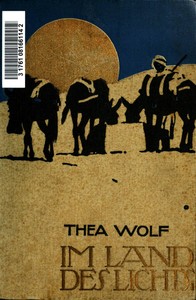
Im Land des Lichts: Ein Streifzug durch Kabylie und Wüste by Thea Wolf
Published in 1929, Im Land des Lichts is Thea Wolf's personal record of her travels through French Algeria. This isn't a grand historical treatise; it's the vivid, immediate diary of a curious outsider stepping into a world vastly different from her own.
The Story
The book follows Wolf's journey in two distinct parts. First, she explores the mountainous Kabylia region, home to the Kabyle Berber people. Here, she focuses on daily life—visiting villages, observing crafts, and describing the complex social structures with a keen, respectful eye. She's fascinated by the people, their resilience, and their rich culture, which stands in stark contrast to the European colonial presence. The second part of the book plunges us into the vastness of the Sahara Desert. The tone shifts as Wolf confronts the sheer scale and silence of the dunes, travels with caravans, and experiences the extreme isolation and beauty of the landscape. The 'plot' is the journey itself: her evolving understanding, her moments of awe, and her candid reflections on what she's witnessing.
Why You Should Read It
What makes this book special is Wolf's voice. She writes with a journalist's eye for detail but a humanist's heart. You feel her wonder when she describes a Kabyle weaving pattern or the colors of a desert sunset. More importantly, you feel her internal struggle. She doesn't hide her European biases, but she consistently questions them. She's critical of simplistic colonial narratives and genuinely tries to see the world through the eyes of the people she meets. Reading it today, the book becomes a double journey: Wolf's physical trip and our own trip back in time to see how one intelligent traveler grappled with cross-cultural understanding nearly a century ago. Her observations on culture, belonging, and the human spirit in harsh environments feel surprisingly current.
Final Verdict
This book is perfect for readers who love immersive travel writing, historical eyewitness accounts, or early feminist literature (traveling alone in the 1920s was no small feat!). It's for anyone tired of romanticized colonial adventures and hungry for a more nuanced, self-aware perspective. Be prepared for a slow, observational pace—it's a thoughtful stroll, not a thriller. But if you let Wolf be your guide, you'll be rewarded with a powerful, poetic, and thought-provoking portrait of a land and its people, seen through the eyes of a woman brave enough to look closely and report back with honesty.
This content is free to share and distribute. Use this text in your own projects freely.
Karen Martin
10 months agoI was skeptical about the depth of this book at first, but the author manages to bridge the gap between theory and practice effectively. I'll be citing this in my upcoming project.
Barbara Gonzalez
2 years agoI've been looking for a reliable source on this topic, and the logic behind each conclusion is easy to follow and verify. I'm genuinely impressed by the quality of this digital edition.
Michael Jackson
5 months agoExceptional clarity on a very complex subject.
Margaret Garcia
4 months agoRight from the opening paragraph, the structural organization allows for quick referencing of key points. I'll be citing this in my upcoming project.






Elizabeth Thompson
4 months agoI've gone through the entire material twice now, and the chapter on advanced strategies offers insights I haven't seen elsewhere. A perfect balance of theory and practical advice.