
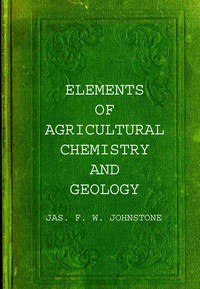
Elements of agricultural chemistry and geology by Jas. F. W. Johnston
Forget everything you think you know about old farming manuals. 'Elements of Agricultural Chemistry and Geology' isn't a simple list of planting tips. It's a foundational argument, a plea for farmers to look beneath their feet.
The Story
Johnston starts with a simple but radical idea: soil is not just dirt. It's a complex, living material that can be understood, analyzed, and improved. The 'plot' follows his methodical breakdown of this idea. He explains what plants are made of (carbon, oxygen, hydrogen, and minerals from the soil). Then, he shows how different soils provide—or fail to provide—these essential building blocks. He talks about manure and fertilizers not as magic, but as specific chemical replacements for what each harvest takes from the ground. The book walks you through his logic, teaching the reader how to think like a agricultural chemist, turning the mystery of crop failure into a solvable puzzle.
Why You Should Read It
What's amazing is feeling the birth of modern thought. You can almost see the lightbulb going on over Johnston's head as he connects ideas. Reading it today, we know he was right, but in 1844, this was cutting-edge, possibly controversial, science. It's humbling and exciting to witness the origin point of concepts like soil fertility and sustainable farming. Johnston writes with a clear, persuasive passion. He's not a detached scientist; he's a man on a mission to improve lives and prevent famine by spreading knowledge. His urgency makes a topic that could be dry feel vitally important.
Final Verdict
This book isn't for everyone. If you're looking for a narrative with characters, look elsewhere. But if you're a history or science enthusiast, a gardener curious about the 'why' behind the advice, or someone interested in the history of food, this is a gem. It’s perfect for readers who enjoy seeing how big ideas begin. Think of it less as an instruction manual and more as the dramatic opening chapter to the story of modern agriculture. You'll never look at a field the same way again.
This masterpiece is free from copyright limitations. Feel free to use it for personal or commercial purposes.
Charles Brown
5 months agoThe balance between academic rigor and readability is perfect.
Christopher Taylor
8 months agoFrom a researcher's perspective, the cross-referencing of different chapters makes it a great study tool. I'll be recommending this to my students and colleagues alike.
Jennifer Miller
1 month agoOne of the most comprehensive guides I've read this year.
Charles Thompson
1 year agoThis is one of those stories where the atmosphere created is totally immersive. I couldn't put it down.
Margaret Taylor
3 months agoHaving explored several resources on this, I find that the transition between theoretical knowledge and practical application is seamless. Definitely a five-star contribution to the field.